
At its most basic, SERP tracking is the process of keeping an eye on where your website shows up on search engine results pages for the keywords that matter to your business. It's the only real way to answer the crucial question: “When a potential customer searches for what I offer, can they find me?”
Why SERP Tracking Is Your SEO Compass
Trying to do SEO without SERP tracking is like sailing across the ocean without a map or a compass. You’re definitely moving, but are you getting closer to your destination or just drifting out to sea? In the world of search optimization, flying blind is a recipe for wasted effort and missed opportunities.
Think of SERP tracking as a form of business intelligence. It takes all your hard SEO work—the content you write, the links you build, the technical fixes you implement—and turns it into something you can actually measure. It gives you a clear, data-backed picture of how your website is really performing where it counts: in front of actual searchers.
To help you get started, here's a quick breakdown of the core components.
Core Components of SERP Tracking at a Glance
| Component | Description | Why It Matters for SEO |
|---|---|---|
| Keyword Monitoring | The continuous process of checking your website's ranking for a specific set of keywords. | This is the foundation. It tells you if you're visible for the terms your customers use to find you. |
| Competitive Analysis | Tracking not just your own rankings, but also those of your direct competitors for the same keywords. | It provides essential market context, showing you where you're winning, where you're losing, and where opportunities lie. |
| Performance Measurement | Correlating changes in your rankings with your SEO activities (e.g., content updates, link building). | This is how you prove your work is effective. It connects your actions to tangible results and demonstrates ROI. |
Now, let's explore how these components come together to form a powerful strategy.
Benchmarking and Competitive Analysis
SERP tracking isn’t just about naval-gazing at your own performance; it’s a powerful competitive intelligence tool. By watching where your rivals rank for your most important keywords, you can start to piece together their entire strategy and find your own openings.
This allows you to:
- Spot "gap" keywords that competitors are ranking for but you’ve completely missed.
- Reverse-engineer competitor tactics that are clearly working to win those top spots.
- Benchmark your progress against the top players in your space to set ambitious but achievable goals.
SERP tracking gives you the context you need to truly understand your position in the market. It doesn't just show you how you're doing; it shows you how you're doing compared to everyone else fighting for the same eyeballs.
Measuring SEO Impact and Proving ROI
So, you published a new blog series, launched a link-building campaign, and fixed a dozen technical issues. Did any of it actually work? SERP tracking is how you find out.
By mapping your SEO initiatives to the fluctuations in your keyword rankings, you can draw a direct line between your actions and their results. This historical data is your single best tool for proving the return on investment (ROI) of your SEO efforts. For a deeper look at the tools that make this possible, learning to master your SEO with a SERP position tracker is a critical next step.
Without this data, you're just guessing what moved the needle, making it nearly impossible to double down on what works and stop wasting time on what doesn't.
How SERP Tracking Works Under the Hood
To really get what SERP tracking is all about, you have to look past the fancy dashboards and dig into the tech that powers them. Think of it like a detective arriving at a crime scene. They can either get a quick text summary of what happened—fast, but missing crucial details—or they can get a full set of crime scene photos that capture everything. SERP tracking tools use two main "investigative" methods to collect their evidence.
These methods are direct HTML scraping and full browser rendering. Each serves a different purpose and gives you a different level of insight into Google's complex, always-changing search results page. Knowing how they work is the key to picking the right tool and actually understanding the data you’re looking at.
This simple flow breaks down the core cycle of SERP tracking: you start with a baseline, measure what happens next, and uncover new opportunities from the data.
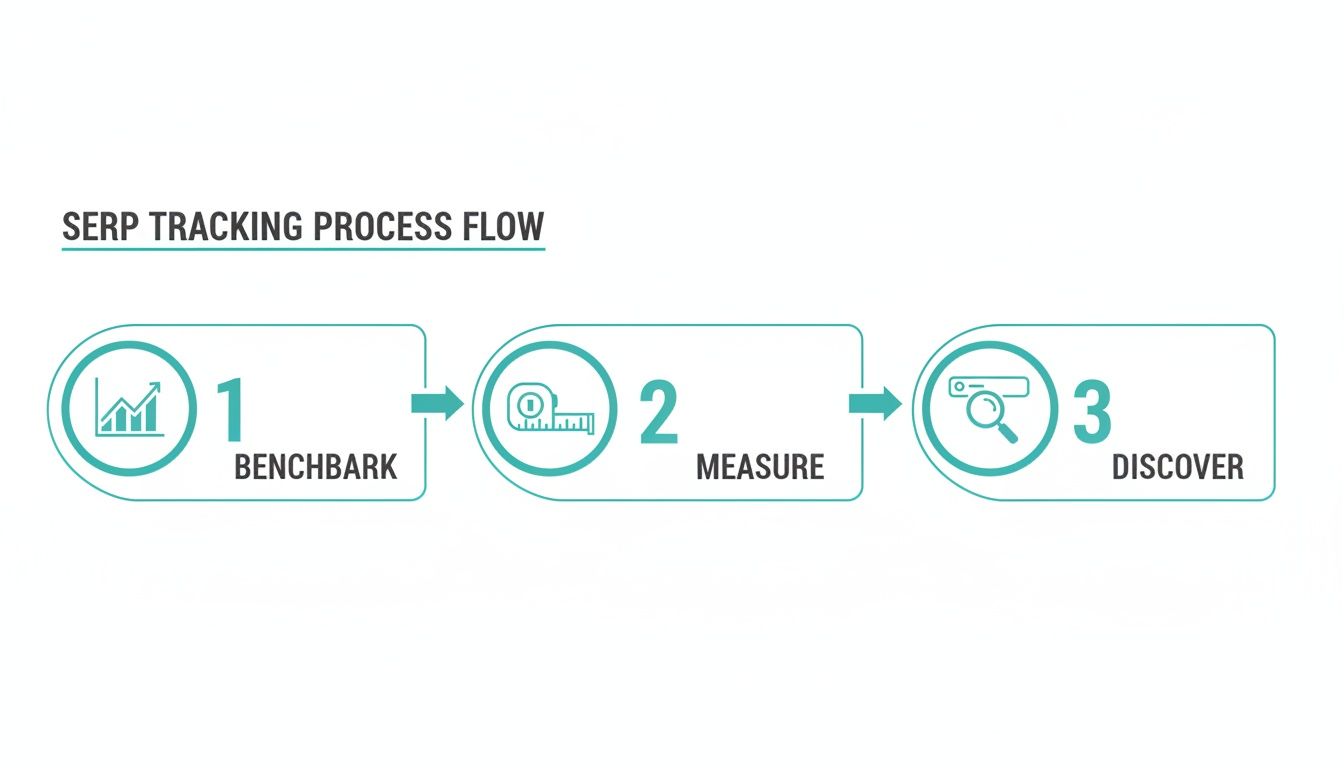
It’s a constant loop. Effective tracking isn't a one-and-done check-in; it's a continuous process of benchmarking, measuring, and discovering.
The Fast Lane with HTML Scraping
Imagine you want to know the chapter titles of a book. Instead of grabbing the beautifully printed final copy, you get the raw, unformatted manuscript from the publisher. It’s not pretty, but you can find the chapter headings in seconds. That's pretty much what direct HTML scraping does.
A scraper is just an automated bot that asks Google’s servers for the raw HTML code of a search results page. It then sifts through that code to pull out specific text-based info, like:
- Page Titles: The main blue link text for each result.
- URLs: The web addresses of the pages that are ranking.
- Meta Descriptions: Those little snippets of text under the title.
This approach is incredibly fast and efficient. Since it's only dealing with raw text, a scraper can grab basic ranking data for thousands of keywords in a ridiculously short amount of time. The speed is great, but it comes at a cost—it almost always misses the bigger picture.
The Full Picture with Browser Rendering
Modern SERPs are way more than a simple list of ten blue links. They're dynamic, interactive pages built with a ton of JavaScript. Things like "People Also Ask" boxes, Knowledge Panels, ad carousels, and map packs are often loaded after the initial HTML has been sent. An HTML scraper won't see any of that.
This is where full browser rendering comes in. Instead of just grabbing the raw manuscript, this method actually opens the SERP in a "headless browser"—think of it as a real web browser, like Chrome, but without a screen. It waits for the page to fully load, just like a person would.
This process executes all the JavaScript, loads all the images, and assembles the page exactly as it appears to a user. It’s the difference between reading a text file and looking at a high-resolution, pixel-perfect photograph of the finished page.
Using this method, a SERP tracking tool can "see" and capture everything, including all the rich features that HTML scrapers are blind to. If you need to know not just your rank, but your actual visibility among ads, images, and other dynamic features, this is the only way to go. You can see how this applies beyond search results in our guide on monitoring webpage changes for things like compliance and competitor analysis.
Overcoming the Technical Hurdles
So why doesn’t everyone just do this? Because gathering this data at scale is really, really hard. Search engines are built to serve humans, not armies of data-collecting bots, and they have some pretty sophisticated defenses in place.
Anyone trying to do this consistently runs into a few major roadblocks:
- IP Blocking and Rate Limiting: Make too many search requests from the same computer (IP address) in a short time, and Google will block you. Fast.
- CAPTCHAs: Those "I'm not a robot" puzzles are designed specifically to stop automated tools in their tracks.
- Dynamic Layouts: Google is constantly A/B testing different page layouts, which can break a scraper that's programmed to look for data in a specific spot.
This is why serious tracking operations rely on specialized SERP APIs. These services have already solved these problems by managing huge pools of proxy IPs, using AI to solve CAPTCHAs, and relying on advanced browser rendering to make sure the data is accurate and complete. They handle all the messy technical stuff so you can focus on the insights.
Key Metrics and SERP Features You Must Monitor
Effective SERP tracking isn't just about knowing where your single link sits on a page—it's about seeing the entire chessboard. While your rank is a great starting point, a modern SEO strategy requires digging much deeper to understand your brand's true visibility. The most successful teams move beyond a simple number and analyze a whole suite of metrics that tell the complete story.
Think of your keyword rank as your street address. It’s important, but it doesn't describe the neighborhood, the traffic, or the other businesses on the block. To get the full picture, you need to track several data points that provide that crucial context.
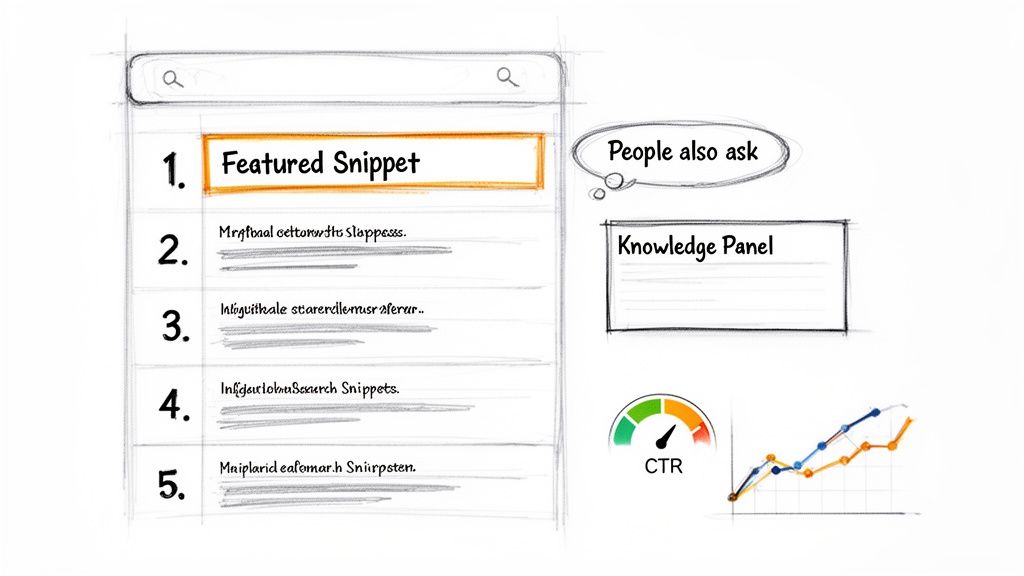
Core Performance Metrics
First things first, you need to establish a baseline with core performance indicators. These are the foundational numbers that will anchor your entire SEO strategy and let you measure progress accurately.
- Organic Position: This is the classic ranking for your URL in the standard "blue link" results. It's still your primary benchmark.
- Ranking URL: Are you ranking with the right page? Sometimes Google might surface a blog post when you want it to show your main product page. This often points to an issue with content relevance or internal linking.
- Search Volume: How many people are actually searching for this keyword each month? This metric is key for prioritizing which terms are worth your time and effort.
- Estimated Click-Through Rate (CTR): Based on your ranking, what percentage of searchers are likely to click your link? This helps you translate rankings into potential traffic.
These metrics are powerful because they work together. For instance, in competitive markets, the top Google positions hog 75% of all organic clicks. The number one spot alone averages a 31.7% CTR, while slipping to position ten nets you a measly 0.8%. Without tracking, you'd also miss that SERP features now occupy over 55% of page one real estate.
Beyond the Blue Links: Modern SERP Features
Today's search results are a dynamic, visually rich environment—a far cry from the simple list of ten blue links they once were. Winning in search now means competing for—and tracking your presence in—a variety of interactive elements called SERP features. These often appear above the #1 organic result, stealing attention and clicks before a user ever scrolls down.
A #1 ranking isn't always the top spot anymore. If a Featured Snippet, an ad carousel, and a "People Also Ask" box are above your link, your "top" position might actually be halfway down the page.
To truly monitor your visibility, a deep understanding of SERP features is absolutely essential.
Key SERP Features to Track
Your SERP tracking has to account for these elements to give you an accurate read on your brand's visibility. If you're not monitoring them, you're missing a massive piece of the puzzle.
Featured Snippets: Often called "position zero," these are the boxes at the very top of the SERP that directly answer a user's question. Capturing a snippet can skyrocket your visibility, even if your page ranks lower down.
People Also Ask (PAA): You've seen these accordion-style boxes that show related questions. Securing a spot in a PAA box is a fantastic way to gain visibility for multiple related queries at once.
Local Pack: For any search with local intent (like "coffee shops near me"), Google shows a map with three business listings. For local businesses, appearing in this pack is often more valuable than the organic rankings below it.
Knowledge Panels: These large panels on the right side of the desktop SERP give a summary of a person, place, or organization. They are absolutely critical for brand reputation and establishing authority.
Image and Video Carousels: For visual queries, Google often shows a horizontal carousel of images or videos. If your content strategy relies on multimedia, tracking your placement here is a must.
By monitoring these features, you get direct clues about what kind of content Google prefers for a specific query. If a video carousel always appears, you know that creating a video is your best shot at ranking. In the end, tracking the full SERP—not just your own link—is the only way to build a strategy that actually aligns with how search engines work today.
Practical Use Cases for SERP Tracking Data
Raw SERP data on its own is a bit like a pile of lumber—it holds a lot of potential, but its real value comes from what you build with it. For different teams, this data is the blueprint for smarter strategies, turning passive observations into decisive action. It’s what connects knowing where you stand with knowing what to do next.
For an SEO specialist, this data is the lifeblood of their daily work. It powers the core workflows that drive organic growth, taking them far beyond simple rank checking and into the realm of strategic intelligence.
Meanwhile, marketing teams use this same information to get a clear, unbiased picture of their brand's visibility. It tells them exactly how they stack up against the competition in the eyes of their target audience.
SEO Workflows Fueled by SERP Data
For SEO pros, SERP tracking is the foundation for several critical tasks. This isn't just about reporting numbers; it's about using those numbers to spot opportunities and defend your turf.
Competitive Gap Analysis: Start by tracking a bucket of high-value keywords for both your site and your top three competitors. You'll quickly see the "gap" keywords—terms they rank for that you don't. This is the lowest-hanging fruit for your next content push.
Algorithm Update Impact Analysis: When a big Google update rolls out, SERP tracking data is your early warning system. Historical rank charts show you precisely which keywords and pages got hit (or helped), letting you diagnose the problem long before your traffic analytics even register a dip.
Content Cannibalization Audits: Do you ever see Google swapping different URLs from your site for the same keyword? That’s a classic cannibalization problem. SERP tracking is the fastest way to catch these conflicts, which dilute your authority and just plain confuse search engines.
SERP tracking data transforms SEO from a practice of guesswork into a discipline of precision. It lets you reverse-engineer a competitor's success, pinpoint the exact moment an algorithm update affected you, and make content decisions based on evidence, not just a hunch.
Marketing and Brand Monitoring Applications
Beyond the nitty-gritty of technical SEO, marketers rely on SERP data to keep a finger on the pulse of brand health and market positioning. This data gives them a real-world look at how the brand shows up on its most important digital storefront: the Google results page.
This became an essential practice in the early 2010s after Google's Panda and Penguin updates caused massive ranking shakeups. By 2015, over 70% of SEOs had switched to dedicated rank trackers because manual checks had become so unreliable. Today, businesses that don't track this data risk missing 25% of SEO opportunities from competitor gaps alone—a blind spot that modern tools easily expose. You can see how these tools evolved in reports on the top rank trackers.
Here are a few key marketing use cases:
Share of Voice (SOV) Measurement: By tracking a broad set of non-branded keywords, marketers can calculate their brand’s visibility relative to everyone else. A rising SOV is a fantastic indicator of growing market authority.
Content Strategy Validation: Did that new content cluster on "financial planning for millennials" actually hit the mark? SERP data gives you the definitive answer, validating whether your content strategy is resonating with search engines and user intent.
Reputation Management: Tracking branded keywords like "[Your Brand] reviews" is non-negotiable. It helps you monitor what potential customers see first, giving you the chance to address negative results or amplify positive ones.
Quality Assurance for Developers
You might be surprised to learn that even development and QA teams can get huge value from SERP data, especially visual data. When you’re launching a new site design or updating brand assets, you have to be sure they render correctly on the SERP itself.
Automated tools can capture screenshots of search results to verify that elements like your favicon, breadcrumbs, and rich snippet previews all appear exactly as intended. This kind of visual evidence is far more reliable than just looking at a ranking number. You can get a better sense of how this works by exploring how a screenshot as a service can automate this entire verification process at scale.
Using APIs to Automate Visual SERP Monitoring
Your rank tracker says you're at position #3. That’s great, right? But what if that #3 spot is buried below a massive ad block, a shopping carousel, and a Featured Snippet? Suddenly, that number doesn't tell the whole story.
This is where the next step in SERP tracking comes in: automated visual monitoring. It shifts the focus from abstract data points to a much more practical question: “What does a searcher actually see?” Capturing the SERP visually gives you undeniable proof of how visible you really are.
Why a Pixel-Perfect View Matters
Think about trying to describe a complex painting just by listing its colors. You’d completely miss the composition, the emotion, and the overall impact. Traditional SERP data is just that list of colors; a screenshot of the SERP is the painting itself.
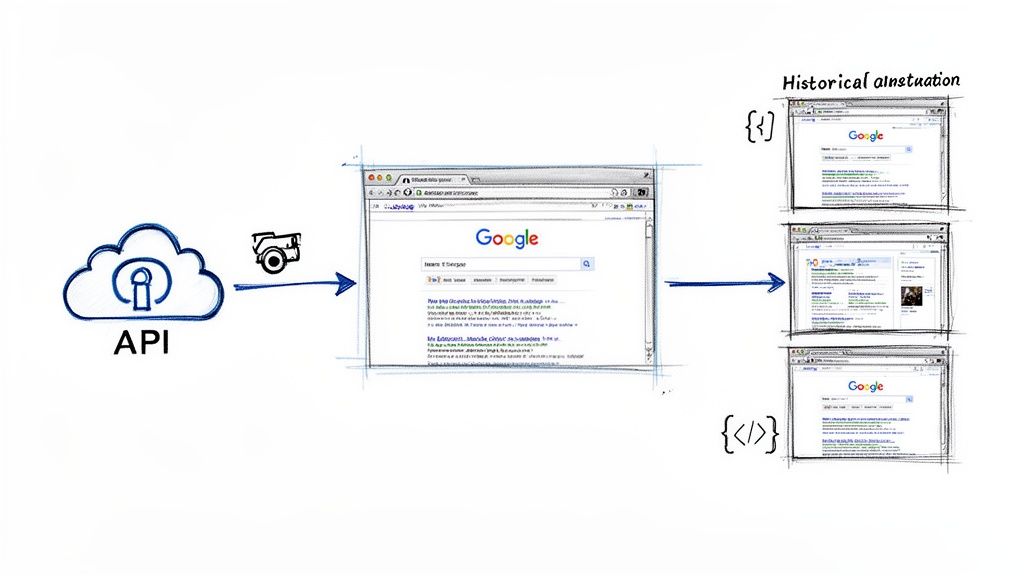
A screenshot API is the engine that powers this visual-first approach. It programmatically captures clean, pixel-perfect images of search results pages at scale. This isn't just about taking a quick snapshot; it's about building a historical, visual archive of your performance over time.
When you capture the SERP exactly as a user sees it, you create an irrefutable record of your digital shelf space. This visual evidence is far more compelling in a boardroom than a spreadsheet of ranking changes.
Developers and SEO teams can integrate a screenshot API directly into their monitoring systems to automate this evidence collection. It adds a powerful new layer of intelligence to your workflow and helps create a more complete SERP results checker that confirms not just your rank, but your actual presentation.
Practical Ways to Use Visual Monitoring
Automating SERP captures opens the door to advanced workflows that typical rank trackers can't handle. These applications go far beyond simple rank verification, giving you deeper and more actionable insights.
Historical SERP Archiving: Imagine capturing full-page screenshots of your most valuable SERPs every day or week. This builds a visual timeline, allowing you to see how layouts evolve, which competitors are running ads, and how new SERP features affect your visibility.
Competitor Ad Monitoring: You can programmatically grab screenshots for your top commercial keywords. This lets you monitor your competitors' ad copy, landing pages, and special offers in real-time, giving you a serious edge for your own paid campaigns.
Element-Specific Capture: Modern screenshot APIs can zero in on specific page elements. You could set it up to capture only the Local Pack, the "People Also Ask" box, or the Knowledge Panel, making it much easier to track your performance inside these critical features.
Capturing SERPs Across Different Devices
The need for this visual detail is more critical than ever. Since 2018, Google's mobile-first indexing has forced the hand of the SEO industry. It pushed 85% of rank trackers to finally separate desktop and mobile data, and the results were eye-opening. For around 60% of keywords, mobile rankings now trail desktop by an average of 15-20 positions. As this deep dive into rank tracking tools shows, treating them as the same is no longer an option.
This is where a flexible screenshot API becomes essential. A tool like ScreenshotEngine lets developers specify the exact device, screen resolution, and user agent for every capture. This gives you the power to:
Capture Mobile vs. Desktop Views: Programmatically render and screenshot the SERP for an iPhone 14 Pro and a standard desktop monitor to see a direct, side-by-side comparison of your visibility.
Generate Clean, Uncluttered Images: You can automatically block cookie banners, pop-ups, and other noise. This ensures your captured SERP images are pristine and ready for analysis or client reports.
Optimize for Different Formats: Choose the best image format for your needs, like PNG for high-fidelity archives or WebP for faster loading in your internal dashboards.
By automating visual SERP monitoring, you stop guessing what your visibility looks like and start seeing it. This approach gives you the hard evidence you need to build a smarter, more resilient SEO strategy.
SERP Tracking FAQs: Your Questions Answered
Alright, we've covered the what and the why. Now, let's get into the nitty-gritty—the practical questions that pop up the moment you start building a real-world SERP tracking strategy. Getting these details right is what turns a simple rank checker into a powerful intelligence-gathering machine.
Let's tackle the common head-scratchers, from timing your checks to staying on the right side of the law.
How Often Should I Actually Check My Rankings?
This is easily the most common question, and the honest answer is: it depends. There’s no single right frequency. The key is to match your tracking rhythm to the pulse of your industry.
For hyper-competitive spaces like e-commerce, affiliate marketing, or news, daily tracking is a must. Rankings for high-value keywords can swing wildly overnight thanks to a competitor's flash sale, a Google algorithm hiccup, or a viral news story. Daily data gives you an early warning system, letting you react before a small dip becomes a major problem.
On the other hand, if you're in a more stable B2B niche or run a local service business, the search results don't change as frantically. Weekly tracking is often plenty to spot meaningful trends without drowning in data noise.
Think of it this way: tracking a high-stakes keyword daily is proactive defense. Tracking a sleepy, long-tail term with the same intensity is probably overkill. Start with a sensible baseline and adjust as you learn how your specific SERPs behave.
Why Is It So Important to Track Different Locations and Devices?
Back in the day, a single ranking was all you needed. Today, that concept is completely obsolete. A search for "best pizza" from a phone in downtown Chicago yields a completely different SERP than the same search from a desktop computer in the suburbs.
This is why any serious SERP tracking has to account for two critical variables:
- Geographic Location: If your business has a physical footprint or serves specific areas, local SERP tracking is non-negotiable. It’s the only way to see what customers in a particular city, state, or even zip code see. This is absolutely vital for winning a spot in the coveted Local Pack.
- Device Type: Google now operates on a mobile-first index, meaning the mobile version of a SERP is the "real" one in their eyes. It's incredibly common for a site to be #1 on desktop but lost on page three for mobile users. Without tracking both, you're only seeing half the picture.
If you ignore these factors, you're flying blind. You could be high-fiving over a #1 desktop ranking in New York City while being totally invisible to mobile users in Los Angeles—a group that might be a massive part of your target market.
Is It Legal and Ethical to Track SERPs?
This is a big one, and the answer isn't a simple yes or no. It all comes down to how you do it. Simply monitoring public search results is perfectly legal. But the automated methods used to gather that data at scale enter a gray area that demands a careful, responsible approach.
When you type a query into Google yourself, you're a regular user. When an automated script hammers their servers with thousands of requests a minute, it puts a heavy load on their infrastructure. This is precisely why search engines have anti-bot systems in place.
To stay above board, you have to play by the rules of the road.
Best Practices for Ethical Data Collection
- Respect
robots.txt: This simple file on every website tells crawlers what they should and shouldn't access. While it's not a legally binding contract, honoring it is a cornerstone of ethical scraping. - Use Official APIs When Available: Some search engines offer paid APIs for structured data access. This is always the cleanest, most reliable, and most compliant route, though it often comes at a higher cost.
- Don't Be a Noisy Neighbor: The fastest way to get blocked is to fire off too many requests from one IP address. A responsible operation uses a pool of high-quality proxy IPs and throttles its request speed to look more like human activity and avoid straining servers.
- Public Data Only: SERP tracking should never touch private information. Any attempt to scrape data behind a login or gather personally identifiable information (PII) is a massive ethical and legal line you should never cross.
By using a reputable SERP API provider or building your own system with these principles baked in, you can get the business-critical intelligence you need without running into trouble.
Ready to stop guessing what your users see and start knowing? With ScreenshotEngine, you can automate the capture of pixel-perfect SERP screenshots across any device, location, or language. Ditch the abstract numbers and start collecting undeniable visual proof.
Try ScreenshotEngine for free today and build a monitoring system backed by real evidence.